Festival vs nightclub vs tour: how marketing changes by scale.
Why copying an arena festival strategy kills a 400-cap club night, and how to match your playbook to your operational scale.
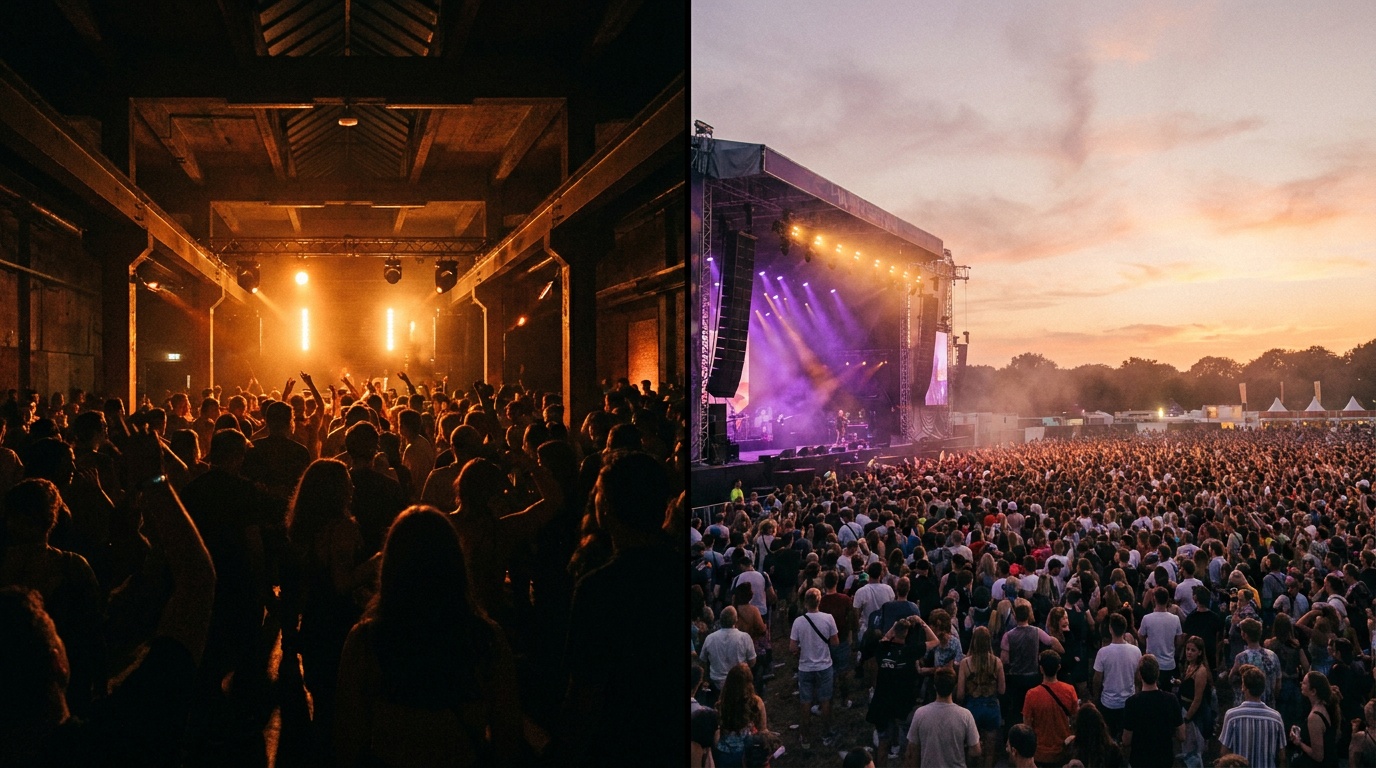
Key takeaways for event promoters
- Weekly club nights operate on 48-hour instinct and hyper-local community loops; multi-day festivals are 9-to-12-month capital deployment operations.
- Artist tours rely on cross-promoter collaboration and geo-targeted presales; venue programming relies on captive Wi-Fi data ingest and membership habituation.
- Campaign pacing, creative fatigue, and channel selection must be tailored to capacity; applying festival tactics to a small club exhausts your audience.
- Your marketing budget as a percentage of gross revenue drops as scale increases: 12-15% for small clubs down to 5-7% for major festivals.
Scale is a different sport, not just a bigger number
The single most common mistake made by junior promoters and inexperienced agencies is treating all live events as identical entities with scaled budgets.
Promoting a 500-capacity underground club night in Manchester has almost nothing in common with marketing a 25,000-capacity multi-stage electronic music festival in London, or routing a 12-date UK artist tour.
Every vertical has its own distinct purchase friction, lead-time velocity, creative cadence, and customer retention dynamics. Let us break down the four core models.
The 4 Live Event Marketing Models Compared
Here is how operational parameters shift across the four primary event categories:
| Dimension | Weekly Club Night (300-800) | Artist Tour (1k-5k / city) | Resident Venue (Weekly) | Multi-Day Festival (10k-50k+) |
|---|---|---|---|---|
| Campaign Window | 3 to 5 weeks | 8 to 14 weeks | Continuous rolling 52-week | 8 to 12 months (Multi-wave) |
| Marketing % Gross | 10% to 15% | 6% to 9% | 7% to 10% (Fixed monthly) | 5% to 8% |
| Dominant Channel | WhatsApp, Student Reps, IG Stories | Spotify Ads, Meta Geo-Targeting | Google Search / Maps, Captive WiFi CRM | Lineup PR, Multi-Wave Meta/TikTok CAPI |
| Purchase Curve | 65% sold in final 72 hours | 50% sold in launch 48h (Fan club) | 40% advance, 60% walk-up / late | 40% launch, 20% waves, 40% final 30d |
| Creative Velocity | 2 to 3 assets per week | 1 core tour package + geo tags | Branded templates + weekly DJs | High-production cinematic trailers + 50+ wave cuts |
Execution Priorities by Event Vertical
1. The Club Night Playbook (300 to 800 Cap)
Club nights succeed or fail on vibe and social proof. Paid ads should focus on hyper-local 5-mile radius targeting, Instagram Story polls, and local WhatsApp groups. Invest in student brand ambassadors who sell tickets peer-to-peer in exchange for free entry and drink perks.
2. The Multi-Day Festival Playbook (10,000+ Cap)
Festivals are destination commitments requiring travel, accommodation, and group consensus. Break your campaign into four distinct announcement waves (Save The Date, Phase 1 Headliners, Stage Takeovers, Day Splits). Offer 3-part deposit payment plans to remove price resistance on £150+ tickets.
3. The Artist Tour Playbook
Tours live on artist fan-base density. Use artist co-branded ads (running ads through the DJ/artist's verified Facebook page to their followers in specific tour cities). Integrate Laylo or Komi for SMS/WhatsApp drops before public on-sale.
4. The Resident Venue & Nightclub Playbook
Venues require perpetual habituation. Install Captive Wi-Fi portals at the door to capture 1,000+ verified CRM contacts every weekend. Build automated re-engagement flows in Klaviyo: if someone visits twice in a month, trigger a VIP table upgrade offer for their next visit.
Across 50+ Broadwick Live Presents campaigns at Magazine London and Drumsheds, matching creative format to venue scale generated over 50,000 advance ticket sales while holding average blended CPA under £3.20.

Common questions answered.
Club nights spend a higher percentage of gross revenue on marketing (10-15%) due to lower ticket prices and shorter campaigns. Major festivals spend 5-8% of gross revenue but deploy significantly higher absolute budgets across longer multi-wave cycles.
Payment plans must go live during the initial Early Bird on-sale. Over 40% of festival attendees opt for monthly split payments when ticket prices exceed £120, dramatically increasing early cash flow and commitment.
Run co-branded Meta ads directly from the artist profile targeted at Spotify listeners and local music interest groups within a 25-mile radius of each tour venue, driving to a dedicated tour routing landing page with single-click city selection.
57% of Tickets Now Sell in the Final 7 Days: What That Means for Your 2026 Campaign
Consumer purchase windows for live events have compressed by 26% since 2022. Here is the operational framework to maintain launch velocity without starving your final 14-day conversion window.
Multi-Wave Festival Lineup Reveal Strategy: Maximising Cash Flow Across 9 Months
Dropping your entire festival lineup in a single graphic is a catastrophic waste of media momentum. Here is the 4-wave release architecture that keeps ticket sales compounding from autumn to festival weekend.
How to Sell Out a 400-Capacity Club Night on Under £500 Ad Spend
You do not need a £5,000 ad budget to sell out a club night. Using the Trippy Visions framework, here is how to sell out 400 to 800-capacity club events on under £500 in total marketing spend.
Engineered to sell out.
Ready to upgrade your campaign pacing, WhatsApp infrastructure, and server-side tracking?